→ 携帯用は別頁

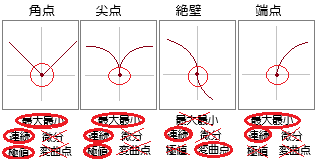
《参考:角点,尖点,絶壁と極値,変曲点》

■角点(かくてん)
この用語は,高校の教科書では使われていない・・・大学数学では,使われることがある
《意味》 右側微分係数,左側微分係数がいずれも存在するが,それらが一致せずに折り目ができる点を「角点」という.
《例》 \(\small\displaystyle y=|x|\) のグラフにおける \(\small\displaystyle x=0\) の点
 条件を満たせば,最大・最小,極値に入れる.変曲点には入れない.
■尖点(せんてん)
この用語は,高校の教科書では使われていない・・・大学数学では,使われることがある
《意味》 折り目ができるもののうちで,その点に左右から近づくと、グラフの傾きがどんどん急になり、最終的に傾きが垂直になるものを「尖点」という.
《例》 \(\small\displaystyle y=\sqrt[3]{x^2}\) のグラフにおける \(\small\displaystyle x=0\) の点
 条件を満たせば,最大・最小,極値に入れる.変曲点には入れない.
■絶壁(垂直接線)
この用語は,数学用語ではない.
《意味》 接線が \(\small x\) 軸に垂直になっているもの.
《例》 下記の例 RP6で \(\displaystyle y=\sqrt[3]{x^2(1-x)}\) のグラフにおける \(\small\displaystyle x=1\) の点,例 RP7で\(\displaystyle y=(x+2)^{\frac{1}{3}}(x-1)^{\frac{2}{3}}\) のグラフにおける \(\small\displaystyle x=-2\) の点など
 当然,最大・最小,極値に入れない.変曲点には入れる.
■端点(たんてん)
この用語は,高校数学で登場する.
《意味》 定義域の端の値のこと
《例》 \(\small\displaystyle y=\sqrt{1-x^2}\) のグラフにおける \(\small\displaystyle x=\pm 1\) の点,\(\small\displaystyle y=\sqrt{x}\) のグラフにおける \(\small\displaystyle x=0\) の点
 最大・最小に入れる.極値には入れない.変曲点にも入れない.
(閉区間で連続を議論し,開区間で微分可能を議論するから,端点では,(片方だけ)連続であるが,微分係数は考えない)
とりあえず,赤字の部分に注意する

最大最小に連続か微分可能か極値に変曲点に
角点〇〇×〇*1×
尖点〇〇×〇*2×
絶壁×〇××〇*3
端点〇△△××
※教科書,参考書などで,明示的に書かれている例・・・引用が古くてごめんね
*1:第一学習社「数学�V」2013年版 \(\small y=|x|\) は \(\small x=0\) で極小値 \(\small 0\) をとる
*2:数研出版「チャート式微分・積分」昭和59年版 \(\small y=\frac{\sqrt[3]{x^2}}{2x+1}\) は \(\small x=0\) で極小値 \(\small 0\) をとる
*3:数研出版「チャート式微分・積分」昭和59年版 \(\small y=(x+1)^{\frac{1}{3}}(x-2)^{\frac{2}{3}}\) は \(\small x=-1\) のとき変曲点
 生成AI:Google gemini
微分不能であるため厳密な意味での標準的変曲点の定義からは外れることがありますが、「垂直接線を持つ広義の変曲点(Vertical Inflection Point)」と呼ばれることがあります。
♪♬∃∀ ∅====♫♠♣♥♦
■無理関数(累乗根)■
増減・極値,凹凸・変曲点,漸近線,グラフ
《例 RP1》
\(\small\displaystyle y=x+\sqrt{1-x^2}\) のグラフ

■関数の定義域
\(\displaystyle y=x+\sqrt{1-x^2}\) において,根号内は0以上でなければならないから,関数は定義域 \(-1\leqq x\leqq 1\) でのみ定義される.
■導関数,第2次導関数
\(\small\displaystyle y'=1-\frac{x}{\sqrt{1-x^2}}\)
\(y'\) の符号が変わる点を調べる.
\(\small\displaystyle \sqrt{1-x^2}=x\hspace{10px}(x\gt 0)\)
⇔ \(\small\displaystyle 2x^2=1\hspace{10px}(x\gt 0)\) ⇔ \(\small\displaystyle x=\frac{1}{\sqrt{2}}\) で極大
\(\small\displaystyle y^{"}=\frac{1}{(x-1)(x+1)\sqrt{1-x^2}}\) は \(-1\lt x\lt 1\) においてつねに負(上に凸)
変曲点はない
■増減凹凸表
\(\small x\)\(\small -1\)\(\small \)\(\small \frac{1}{\sqrt{2}}\)\(\small \)\(\small 1\)
\(\small y'\)\(\small \xcancel{\hspace{20px}}\)\(\small +\)\(\small 0\)\(\small -\)\(\small \xcancel{\hspace{20px}}\)
\(\small y''\)\(\small \xcancel{\hspace{20px}}\)\(\small -\)\(\small -\)\(\small -\)\(\small \xcancel{\hspace{20px}}\)
\(\small y\)\(\small -1\)\(\small \sqrt{2}\)\(\small 1\)
■漸近線
《縦線形》
\(\small x\rightarrow a\) のとき \(\small y\rightarrow \pm\infty\) となる有限の値 \(a\) はないから,縦線 \(\small x=a\) の形)の漸近線はない
《横線形》ない
《斜め線形》ない
■まとめ
極大値 \(\small x=\frac{1}{\sqrt{2}}\) のとき,極大値 \(\small \sqrt{2}\)  (→ ●)
極小値 なし
※ 定義域の端の点(→ ●)は,極値とは言わない
変曲点 なし
漸近線 なし
《例 RP2》
\(\displaystyle y=\frac{x}{\sqrt{x^2+1}}\) のグラフ

■導関数,第2次導関数
\(\displaystyle y'=\frac{1}{(x^2+1)^{\frac{3}{2}}}\)
\(y'\) の符号が変わる点を調べる.\(y'\gt 0\) だから符号の変化する点はない
\(\displaystyle y^{"}=-\frac{3x}{(x^2+1)^{\frac{5}{2}}}\)
\(y^{''}\) の符号が変わる点を調べる.\(\small\displaystyle x=0\) のとき, 変曲点
■増減凹凸表
\(\small x\)\(\small 0\)
\(\small y'\)\(\small +\)\(\small +\)\(\small +\)
\(\small y''\)\(\small +\)\(\small 0\)\(\small -\)
\(\small y\)\(\small 0\)
■漸近線
《縦線形》
\(\small x\rightarrow a\) のとき \(\small y\rightarrow \pm\infty\) となる有限の値 \(a\) はないから,縦線 \(\small x=a\) の形)の漸近線はない
《横線形》\(\small\displaystyle \lim_{x\rightarrow\infty}y= \lim_{x\rightarrow\infty}\frac{x}{\sqrt{x^2+1}}=\lim_{x\rightarrow\infty}\frac{1}{\sqrt{1+\frac{1}{x^2}}}=1\)
\(\small x\rightarrow +\infty\) のとき 漸近線は \(y=1\)
\(\small\displaystyle \lim_{x\rightarrow -\infty}y= \lim_{x\rightarrow-\infty}\frac{x}{\sqrt{x^2+1}}= \lim_{t\rightarrow\infty}\frac{-t}{\sqrt{t^2+1}}\)
\(\small\displaystyle =\lim_{t\rightarrow\infty}\frac{-1}{\sqrt{1+\frac{1}{t^2}}}=-1\)
\(\small x\rightarrow -\infty\) のとき 漸近線は \(y=-1\)
《斜め線形》横線形の漸近線があるから,斜め線形の漸近線はない
■まとめ
極大値 なし
極小値 なし
変曲点 \(\small (0,0)\) (→ ●)
漸近線の方程式 \(\small\displaystyle y=1, y=-1\) (→ ---)

《例 RP3》
\(\displaystyle y=x+\sqrt{x^2-1}\) のグラフ

■関数の定義域
\(\displaystyle y=x+\sqrt{x^2-1}\) において,根号内は0以上でなければならないから,関数は定義域 \(x\leqq -1, 1\leqq x\) でのみ定義される.
■導関数,第2次導関数
\(\displaystyle y'=\frac{\sqrt{x^2-1}+x}{\sqrt{x^2-1}}\)
\(y'\) の符号が変わる点を調べる.\(\small\displaystyle x\geqq 1\) のとき,分母分子とも正だから \(y'\gt 0\).\(\small\displaystyle x\leqq -1\) のとき,\(\small\displaystyle t=-x\) とおくと,\(\small \displaystyle y'=\frac{\sqrt{t^2-1}-t}{\sqrt{t^2-1}}\)
\(\small\displaystyle \sqrt{t^2-1}\lt t\) だから \(y'\lt 0\)
以上から,符号の変化する点はない
\(\displaystyle y^{"}=\frac{(\sqrt{x^2-1}-x)(\sqrt{x^2-1}+x)}{(x^2-1)^{\frac{3}{2}}}\)
\(y^{''}\) の符号が変わる点を調べる.\(\small\displaystyle x\geqq 1\) のとき, \(y^{''}\lt 0\).\(\small\displaystyle x\leqq -1\) のとき, \(y^{''}\lt 0\).つねに,上に凸
■増減凹凸表
\(\small x\)\(\small -1\)\(\small 1\)
\(\small y'\)\(\small -\)\(\small \xcancel{\hspace{20px}}\)\(\small \xcancel{\hspace{20px}}\)\(\small \xcancel{\hspace{20px}}\)\(\small +\)
\(\small y''\)\(\small -\)\(\small \xcancel{\hspace{20px}}\)\(\small \xcancel{\hspace{20px}}\)\(\small \xcancel{\hspace{20px}}\)\(\small -\)
\(\small y\)\(\small -1\)\(\small \xcancel{\hspace{20px}}\)\(\small 1\)
■漸近線
《縦線形》
\(\small x\rightarrow a\) のとき \(\small y\rightarrow \pm\infty\) となる有限の値 \(a\) はないから,縦線 \(\small x=a\) の形)の漸近線はない
《斜め線形》\(\small\displaystyle \lim_{x\rightarrow\infty}\frac{y}{x}=\lim_{x\rightarrow\infty}\frac{x+\sqrt{x^2-1}}{x}\)
\(\small\displaystyle =\lim_{x\rightarrow\infty}(1+\sqrt{1-\frac{1}{x^2}})=2=m\) とおく
\(\small\displaystyle \lim_{x\rightarrow\infty}(y-mx)=\lim_{x\rightarrow\infty}(x+\sqrt{x^2-1}-2x)\)
\(\small\displaystyle =\lim_{x\rightarrow\infty}\frac{x^2-1-x^2}{\sqrt{x^2-1}+x}=\lim_{x\rightarrow\infty}\frac{-1}{\sqrt{x^2-1}+x}=0=k\) とおく
漸近線の方程式は,\(\small y=mx+k=2x\)
《横線形》\(\small\displaystyle \lim_{x\rightarrow-\infty}y=\lim_{t\rightarrow\infty}(-t+\sqrt{t^2-1})\)
\(\small\displaystyle =\lim_{t\rightarrow\infty}\frac{t^2-1-t^2}{\sqrt{t^2-1}+t}=0\)
漸近線は \(y=0\)
■まとめ
極大値 なし
極小値 なし(定義域の端の値は,極値と呼ばない)
変曲点 なし
漸近線の方程式 \(\small\displaystyle y=0, y=2x\) (→ ---)
《例 RP4》
\(\displaystyle y=x\sqrt{4-x^2}\) のグラフ

■関数の定義域
\(\displaystyle y=x\sqrt{4-x^2}\) において,根号内は0以上でなければならないから,関数は定義域 \(-2\leqq x\leqq 2\) でのみ定義される.
■導関数,第2次導関数
\(\displaystyle y'=-\frac{2(x^2-2)}{\sqrt{4-x^2}}\)
\(y'\) の符号が変わる点を調べる.\(\small\displaystyle x=\pm\sqrt{2}\) で極値となる.
\(\displaystyle y^{"}=-\frac{2x(x^2-6)}{(x-2)(x+2)\sqrt{4-x^2}}\)
\(y^{''}\) の符号が変わる点を調べる.\(\small\displaystyle x=0\) で変曲点になる.\(\small\displaystyle x=\pm\sqrt{6}\) は定義域の外だから,変曲点ではない.
■増減凹凸表
\(\small x\)\(\small -2\)\(\small -\sqrt{2}\)\(\small 0\)\(\small \sqrt{2}\)\(\small 2\)
\(\small y'\)\(\small \xcancel{\hspace{20px}}\)\(\small -\)\(\small 0\)\(\small +\)\(\small +\)\(\small +\)\(\small 0\)\(\small-\)\(\small \xcancel{\hspace{20px}}\)
\(\small y''\)\(\small \xcancel{\hspace{20px}}\)\(\small +\)\(\small +\)\(\small +\)\(\small 0\)\(\small -\)\(\small -\)\(\small -\)\(\small \xcancel{\hspace{20px}}\)
\(\small y\)\(\small 0\)\(\small -2\)\(\small 0\)\(\small 2\)\(\small 0\)
■漸近線
《縦線形》
\(\small x\rightarrow a\) のとき \(\small y\rightarrow \pm\infty\) となる有限の値 \(a\) はないから,縦線 \(\small x=a\) の形)の漸近線はない
《斜め線形》漸近線はない
《横線形》漸近線はない
■まとめ
極大値 \(x=\sqrt{2}\) のとき極大値 \(2\) (→ ●)
極小値 \(x=-\sqrt{2}\) のとき極小値 \(-2\) (→ ●)
  (定義域の端の値は,極値と呼ばない)
変曲点 \( (0, 0) \) (→ ●)
漸近線の方程式 なし

《例 RP5》
\(\displaystyle y=\sqrt{x^2-3x+2}\) のグラフ

■関数の定義域
\(\displaystyle y=\sqrt{x^2-3x+2}\) において,根号内は0以上でなければならないから,関数は定義域 \(x\leqq 1, x\geqq 2\) でのみ定義される.
■導関数,第2次導関数
\(\displaystyle y'=\frac{2x-3}{2\sqrt{x^2-3x+2}}\)
\(y'\) の符号が変わる点を調べる.\(\small\displaystyle x=\frac{3}{2}\)は定義域の外にあるから,極値ではない.
 (また,定義域の端の値も極値と呼ばない)
\(\displaystyle y^{"}=-\frac{1}{4(x^2-3x+2)^{\frac{3}{2}}}\)
\(y^{''}\) の符号が変わる点を調べる.定義域 \(x\leqq 1, x\geqq 2\) において,つねに \(\small\displaystyle y^{''}\lt 0\) だから変曲点はない.
■増減凹凸表
\(\small x\)\(\small 1\)\(\small \frac{3}{2}\)\(\small 2\)
\(\small y'\)\(\small -\)\(\small \xcancel{\hspace{20px}}\)\(\small \xcancel{\hspace{20px}}\)\(\small \xcancel{\hspace{20px}}\)\(\small \xcancel{\hspace{20px}}\)\(\small \xcancel{\hspace{20px}}\)\(\small +\)
\(\small y''\)\(\small -\)\(\small \xcancel{\hspace{20px}}\)\(\small \xcancel{\hspace{20px}}\)\(\small \xcancel{\hspace{20px}}\)\(\small \xcancel{\hspace{20px}}\)\(\small \xcancel{\hspace{20px}}\)\(\small -\)
\(\small y\)\(\small\displaystyle\textcolor{red}{ 0}\)\(\small \xcancel{\hspace{20px}}\)\(\small \xcancel{\hspace{20px}}\)\(\small \xcancel{\hspace{20px}}\)\(\small\displaystyle\textcolor{red}{ 0}\)
■漸近線
《縦線形》
\(\small x\rightarrow a\) のとき \(\small y\rightarrow \pm\infty\) となる有限の値 \(a\) はないから,縦線 \(\small x=a\) の形)の漸近線はない
《斜め線形》
\(\small \displaystyle \lim_{x\rightarrow \infty}\frac{y}{x}=\lim_{x\rightarrow\infty}\frac{\sqrt{x^2-3x+2}}{x}\)
\(\small \displaystyle =\lim_{x\rightarrow\infty}\sqrt{1-\frac{3}{x}+\frac{2}{x^2}}=1=m\) とおく
\(\small \displaystyle \lim_{x\rightarrow \infty}(y-mx)=\lim_{x\rightarrow\infty}(\sqrt{x^2-3x+2}-x)\)
\(\small \displaystyle =\lim_{x\rightarrow\infty}\frac{x^2-3x+2-x^2}{\sqrt{x^2-3x+2}+x}=\lim_{x\rightarrow\infty}\frac{-3x+2}{\sqrt{x^2-3x+2}+x}\)
\(\small \displaystyle =\lim_{x\rightarrow\infty}\frac{-3+\frac{2}{x}}{\sqrt{1-\frac{3}{x}+\frac{2}{x^2}}+1}=-\frac{3}{2}=k\) とおく
\(\small \displaystyle y=mx+k=x-\frac{3}{2}\)
\(\small \displaystyle \lim_{x\rightarrow -\infty}\frac{y}{x}=\lim_{x\rightarrow -\infty}\frac{\sqrt{x^2-3x+2}}{x}\)
\(\small \displaystyle =\lim_{t\rightarrow \infty}\frac{\sqrt{t^2+3t+2}}{-t}=-\lim_{t\rightarrow \infty}\sqrt{1+\frac{3}{t}+\frac{2}{t^2}}=-1=m\) とおく
\(\small \displaystyle \lim_{x\rightarrow -\infty}(y-mx)=\lim_{x\rightarrow-\infty}(\sqrt{x^2-3x+2}+x)\)
\(\small \displaystyle =\lim_{t\rightarrow\infty}(\sqrt{t^2+3t+2}-t)=\lim_{t\rightarrow\infty}\frac{t^2+3t+2-t^2}{\sqrt{t^2+3t+2}+t}\)
\(\small \displaystyle =\lim_{t\rightarrow\infty}\frac{3t+2}{\sqrt{t^2+3t+2}+t}=\lim_{t\rightarrow\infty}\frac{3+\frac{2}{t}}{\sqrt{1+\frac{3}{t}+\frac{2}{t^2}}+1}\)
\(\small \displaystyle =\frac{3}{2}=k\) とおく
\(\small \displaystyle y=mx+k=-x+\frac{3}{2}\)
《横線形》(斜め線の漸近線があるから,横線の漸近線はない)
■まとめ
極大値 なし
極小値 なし
変曲点 なし
漸近線の方程式 \(y=x-\frac{3}{2}, y=-x+\frac{3}{2}\) (→ −)
《例 RP6》
\(\displaystyle y=\sqrt[3]{x^2(1-x)}\) のグラフ

■導関数,第2次導関数
\(\displaystyle y'=-\frac{3x-2}{3(1-x)^{\frac{2}{3}}x^{\frac{1}{3}}}\)
\(y'\) の符号が変わる点を調べる.\(\small\displaystyle x=\frac{2}{3}\)で極大値になる.
\(\small\displaystyle x=0\) のとき,\(y',y^{''}\) は定義されない(導関数,第2次導関数とも定まらない)が,\(y\) が存在し,周囲のどの値よりも小さいから「極小」になる.
※このような折れ線になっているグラフでは,微分係数が存在しない(左右で傾きが違う)が,極値が存在する ⇔ \(y=|x|\) を分かりやすい例として覚えておくとよい
\(\displaystyle y^{"}=(x+2)e^x\)
\(y^{''}\) の符号が変わる点を調べる.\(\small\displaystyle x=1\)で変曲点になる.
\(\small\displaystyle x=1\) のとき,\(y',y^{''}\) は定義されない(導関数,第2次導関数とも定まらない)が,\(y\) が存在し,凹凸が変化しているから変曲点になる.
※このような絶壁の形のグラフでも,変曲点になることを覚えておくとよい
■増減凹凸表
\(\small x\)\(\small 0\)\(\small \frac{2}{3}\)\(\small 1\)
\(\small y'\)\(\small -\)\(\small \xcancel{\hspace{20px}}\)\(\small +\)\(\small 0\)\(\small -\)\(\small \xcancel{\hspace{20px}}\)\(\small -\)
\(\small y''\)\(\small -\)\(\small \xcancel{\hspace{20px}}\)\(\small -\)\(\small -\)\(\small -\)\(\small \xcancel{\hspace{20px}}\)\(\small +\)
\(\small y\)\(\small\displaystyle\textcolor{red}{ 0}\)\(\small -\frac{\sqrt[3]{4}}{3}\)\(\small\displaystyle\textcolor{red}{ 0}\)
■漸近線
《縦線形》
\(\small x\rightarrow a\) のとき \(\small y\rightarrow \pm\infty\) となる有限の値 \(a\) はないから,縦線 \(\small x=a\) の形)の漸近線はない
《斜め線形》
\(\small \displaystyle \lim_{x\rightarrow \infty}\frac{y}{x}=\lim_{x\rightarrow\infty}\frac{\sqrt[3]{x^2(1-x)}}{x}\)
\(\small \displaystyle =\lim_{x\rightarrow\infty}\sqrt[3]{1-\frac{1}{x}}=-1=m\) とおく
\(\small \displaystyle \lim_{x\rightarrow \infty}(y-mx)=\lim_{x\rightarrow\infty}(\sqrt[3]{x^2(1-x)}+x)\)
\(\small \displaystyle =\lim_{x\rightarrow\infty}(x\sqrt[3]{\frac{1}{x}-1}+1)=\lim_{t\rightarrow 0}\frac{(t-1)^{\frac{1}{3}}+1}{t}=I\) とおく
《ロピタルの定理》
\(\small\displaystyle x\rightarrow 0\) のとき \(\small\displaystyle f(x)\rightarrow 0, g(x)\rightarrow 0\) ならば
\(\small\displaystyle \lim_{x\rightarrow 0}\frac{f(x)}{g(x)}=\lim_{x\rightarrow 0}\frac{f'(x)}{g'(x)}\)
\(\small \displaystyle I=\lim_{t\rightarrow 0}\frac{1}{3}(t-1)^{-\frac{2}{3}}=\frac{1}{3}=k\) とおく
\(\small \displaystyle y=mx+k=-x+\frac{1}{3}\)
\(\small \displaystyle x\rightarrow-\infty\) のときも同様
《横線形》(斜め線の漸近線があるから,横線の漸近線はない)
■まとめ
極大値 \(x=\frac{2}{3}\) のとき極大値 \(-\frac{\sqrt[3]{4}}{3}\) (→ ●)
極小値 \(x=0\) のとき極小値 \(0\) (→ ●)
変曲点 \(\small\displaystyle (1,0)\) (→ ●)
漸近線の方程式 \(y=-x+\frac{1}{3}\) (→ −)

《例 RP7》
\(\displaystyle y=(x+2)^{\frac{1}{3}}(x-1)^{\frac{2}{3}}\) のグラフ

■導関数,第2次導関数
\(\displaystyle y'=\frac{x+1}{(x-1)^{\frac{1}{3}}(x+2)^{\frac{2}{3}}}\)
\(y'\) の符号が変わる点を調べる.\(\small\displaystyle x=-1\)で極大値になる.
\(\small\displaystyle x=1\) のとき,\(y',y^{''}\) は定義されない(導関数,第2次導関数とも定まらない)が,\(y\) が存在し,周囲のどの値よりも小さいから「極小」になる.
※このような角点かどてん(折リ目)のあるグラフでは,微分係数が存在しない(左右で傾きが違う)が,極値が存在する ⇔ \(y=|x|\) を分かりやすい例として覚えておくとよい
\(\displaystyle y^{"}=-\frac{2}{(x-1)^{\frac{4}{3}}(x+2)^{\frac{5}{3}}}\)
\(y^{''}\) の符号が変わる点を調べる.\(\small\displaystyle x=-2\)で変曲点になる.
\(\small\displaystyle x=-2\) のとき,\(y',y^{''}\) は定義されない(導関数,第2次導関数とも定まらない)が,\(y\) が存在し,凹凸が変化しているから変曲点になる.
※このような絶壁の形のグラフでも,変曲点になることを覚えておくとよい
■増減凹凸表
\(\small x\)\(\small -2\)\(\small -1\)\(\small 1\)
\(\small y'\)\(\small +\)\(\small \xcancel{\hspace{20px}}\)\(\small +\)\(\small 0\)\(\small -\)\(\small \xcancel{\hspace{20px}}\)\(\small +\)
\(\small y''\)\(\small +\)\(\small \xcancel{\hspace{20px}}\)\(\small -\)\(\small -\)\(\small -\)\(\small \xcancel{\hspace{20px}}\)\(\small -\)
\(\small y\)\(\small\displaystyle\textcolor{red}{ 0}\)\(\small \sqrt[3]{4}\)\(\small\displaystyle\textcolor{red}{ 0}\)
■漸近線
《縦線形》
\(\small x\rightarrow a\) のとき \(\small y\rightarrow \pm\infty\) となる有限の値 \(a\) はないから,縦線 \(\small x=a\) の形)の漸近線はない
《斜め線形》
\(\small \displaystyle \lim_{x\rightarrow \infty}\frac{y}{x}=\lim_{x\rightarrow\infty}\frac{(x+2)^{\frac{1}{3}}(x-1)^{\frac{2}{3}}}{x}\)
\(\small \displaystyle =\lim_{x\rightarrow\infty}(1+\frac{2}{x})^{\frac{1}{3}}(1-\frac{1}{x})^{\frac{2}{3}}=1=m\) とおく
\(\small \displaystyle \lim_{x\rightarrow \infty}(y-mx)=\lim_{x\rightarrow\infty}((x+2)^{\frac{1}{3}}(x-1)^{\frac{2}{3}}-x)\)
\(\small \displaystyle =\lim_{x\rightarrow\infty}x((1+\frac{2}{x})^{\frac{1}{3}}(1-\frac{1}{x})^{\frac{2}{3}}-1)\)
\(\small \displaystyle =\lim_{t\rightarrow 0}\frac{(1+2t)^{\frac{1}{3}}(1-t)^{\frac{2}{3}}-1}{t}=I\) とおく
《ロピタルの定理》
\(\small\displaystyle x\rightarrow 0\) のとき \(\small\displaystyle f(x)\rightarrow 0, g(x)\rightarrow 0\) ならば
\(\small\displaystyle \lim_{x\rightarrow 0}\frac{f(x)}{g(x)}=\lim_{x\rightarrow 0}\frac{f'(x)}{g'(x)}\)
\(\small \displaystyle I=\lim_{t\rightarrow 0}\left\{\frac{2}{3}(1+2t)^{-\frac{2}{3}}(1-t)^{\frac{2}{3}}+(1+2t)^{\frac{1}{3}}(-\frac{2}{3})(1-t)^{-\frac{1}{3}}\right\}\)
\(\small\displaystyle =\frac{2}{3}-\frac{2}{3}=0=k\) とおく
\(\small \displaystyle y=mx+k=x\)
\(\small \displaystyle x\rightarrow-\infty\) のときも同様
《横線形》(斜め線の漸近線があるから,横線の漸近線はない)
■まとめ
極大値 \(x=-1\) のとき極大値 \(\sqrt[3]{4}\) (→ ●)
極小値 \(x=1\) のとき極小値 \(0\) (→ ●)
変曲点 \(\small\displaystyle (-2,0)\) (→ ●)
漸近線の方程式 \(y=x\) (→ −)
《例 RP8》
\(\displaystyle y=\sqrt[3]{\frac{x+1}{x-1}}\) のグラフ

■導関数,第2次導関数
\(\displaystyle y'=-\frac{2}{3(x-1)^{\frac{4}{3}}(x+1)^{\frac{2}{3}}}\) の符号はつねに負
\(\displaystyle y^{"}=\frac{4(3x+1)}{9(x-1)^{\frac{7}{3}}(x+1)^{\frac{5}{3}}}\)
\(y^{''}\) の符号が変わる点を調べる.\(\small\displaystyle x=-1,-\frac{1}{3}\)で変曲点になる.\(x=1\) は,\(y\) が定義されておらず,変曲点ではない.
\(\small\displaystyle x=-1\) のとき,\(y',y^{''}\) は定義されない(導関数,第2次導関数とも定まらない)が,\(y\) が存在し,凹凸が変化しているから変曲点になる.
※このような絶壁の形のグラフでも,変曲点になることを覚えておくとよい
■増減凹凸表
\(\small x\)\(\small -1\)\(\small -\frac{1}{3}\)\(\small 1\)
\(\small y'\)\(\small -\)\(\small \xcancel{\hspace{20px}}\)\(\small -\)\(\small -\)\(\small -\)\(\small \xcancel{\hspace{20px}}\)\(\small -\)
\(\small y''\)\(\small -\)\(\small \xcancel{\hspace{20px}}\)\(\small +\)\(\small 0\)\(\small -\)\(\small \xcancel{\hspace{20px}}\)\(\small +\)
\(\small y\)\(\small\displaystyle\textcolor{red}{ 0}\)\(\small -\frac{1}{\sqrt[3]{2}}\)\(\small\displaystyle\xcancel{\hspace{20px}}\)
■漸近線
《縦線形》
\(\small x\rightarrow 1\) のとき \(\small y\rightarrow \pm\infty\) となるから,縦線 \(\small x=1\) の形)は漸近線
《横線形》
\(\small \displaystyle \lim_{x\rightarrow \infty}y=\lim_{x\rightarrow\infty}\sqrt[3]{\frac{1+\frac{1}{x}}{1-\frac{1}{x}}}=1\)
\(\small \displaystyle y=1\) が漸近線
\(\small \displaystyle x\rightarrow-\infty\) のときも同様
《斜め線形》 (斜め線の漸近線があるから,横線の漸近線はない)
■まとめ
極大値 なし
極小値 なし
変曲点 \(\small\displaystyle (-1,0),(-\frac{1}{3},-\frac{1}{\sqrt[3]{2}})\) (→ ●)
漸近線の方程式 \(y=1, x=1\) (→ −)

《例 RP9》
\(\displaystyle y=\sqrt[3]{x^2}(x-5)\) のグラフ

■導関数,第2次導関数
\(\displaystyle y'=\frac{5(x-2)}{3\sqrt[3]{x}}\)
\(y^{'}\) の符号が変わる点を調べる ⇒ \(\small\displaystyle x=0,2\)
※ \(\small x=0\) では,\(\small y'\) は定義されないが,その前後で \(\small y'\) の符号は変化する
\(\displaystyle y^{"}=\frac{10(x+1)}{9x^{\frac{4}{3}}}\)
\(y^{''}\) の符号が変わる点を調べる ⇒ \(\small\displaystyle x=-1\)
■増減凹凸表
\(\small x\)\(\small -1\)\(\small 0\)\(\small 2\)
\(\small y'\)\(\small +\)\(\small +\)\(\small +\)\(\small \xcancel{\hspace{20px}}\)\(\small -\)\(\small 0\)\(\small +\)
\(\small y''\)\(\small -\)\(\small 0\)\(\small +\)\(\small \xcancel{\hspace{20px}}\)\(\small +\)\(\small +\)\(\small +\)
\(\small y\)\(\small\displaystyle -6\)\(\small 0\)\(\small\displaystyle -3\sqrt[3]{4}\)
■漸近線
《縦線形》
有限の値 \(a\) について \(\small x\rightarrow a\) のとき \(\small y\rightarrow \pm\infty\) となるものはないから,縦線 \(\small x=a\) の形)の漸近線はない
《横線形・斜め線形》
\(\small \displaystyle \lim_{x\rightarrow \infty}y=\lim_{x\rightarrow\infty}\sqrt[3]{x^2}(x-5)=\infty\)
\(\small \displaystyle \lim_{x\rightarrow \infty}\frac{y}{x}=\lim_{x\rightarrow\infty}\frac{\sqrt[3]{x^2}(x-5)}{x}=\lim_{x\rightarrow\infty}(\sqrt[3]{x^2}-\frac{5}{x^{\frac{1}{3}}})=\infty\)
\(\small x\rightarrow \infty\) のとき,横線形・斜め線形の漸近線はない
\(\small \displaystyle x\rightarrow-\infty\) のときも同様
■まとめ
極大値 \(\small x=0\) のとき,極大値 \(\small 0\) (→ ●)
極小値 \(\small x=2\) のとき,極小値 \(\small -3\sqrt[3]{4}\) (→ ●)
変曲点 \(\small\displaystyle (-1,-6)\) (→ ●)
漸近線 なし
《例 RP10》
\(\displaystyle y^2=x^2(1-x)\) のグラフ

■多価関数
 この関数を \(\small y\) について解かれた形に直すと, \(\small\displaystyle y=\pm x\sqrt{1-x}\) となって,1つの \(\small x\) の値に対して,2つの \(\small y\) が対応する.
 このように,1つの \(\small x\) の値に対して,2つ以上の \(\small y\) が対応するものを多価関数という(この問題では,二価関数).高校数学でよく見る多価関数として,円の方程式がある.
\(\small\displaystyle x^2+y^2=1\) ⇔ \(\small\displaystyle y=\pm\sqrt{1-x^2}\)
 この問題のように,正負だけが異なる2つのグラフになるときは,一方だけを調べて,符号が逆のものと張り合わせるとよい.
■導関数,第2次導関数
\(\displaystyle y=x\sqrt{1-x}\) について
\(\displaystyle y'=\frac{2-3x}{2\sqrt{1-x}}\)
\(y^{'}\) の符号が変わる点を調べる ⇒ \(\small\displaystyle x=\frac{2}{3} \)
\(y^{''}\) の符号が変わる点を調べる ⇒ \(\small\displaystyle x=\frac{4}{3}\) は定義域の外になる.\(x\lt 1\) のとき,\(y^{''}\lt 0\)
■増減凹凸表
\(\small x\)\(\small \frac{2}{3}\)\(\small 1\)
\(\small y'\)\(\small +\)\(\small 0\)\(\small -\)\(\small \xcancel{\hspace{20px}}\)
\(\small y''\)\(\small -\)\(\small -\)\(\small -\)\(\small \xcancel{\hspace{20px}}\)
\(\small y\)\(\small \frac{2}{3\sqrt{3}}\)\(\small 0\)
■まとめ
極大値 \(\small x=\frac{2}{3}\) のとき,極大値\(\small \frac{2}{3\sqrt{3}}\) (→ ●)
極小値 \(\small x=\frac{2}{3}\) のとき,極小値 \(\small -\frac{2}{3\sqrt{3}}\) (→ ●)
変曲点 \(\small\displaystyle (1,0)\) (→ ●)
漸近線 なし
...(PC版)メニューに戻る